
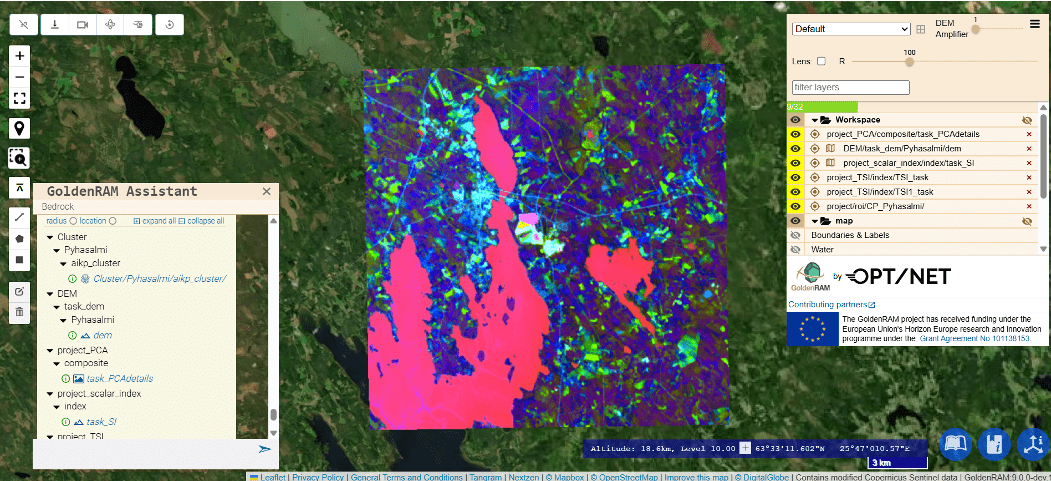
GoldenRAM results were shared at the International Scientific and Technical Conference on Information Technologies in Metallurgy and Mechanical Engineering (ITMM 2026), showing how AI-powered Earth Observation keeps pace with Ukraine’s mining sector, even when the ground is unreachable.
ITMM-2026 brought together researchers from Ukraine, Germany, and Poland in an online forum organised by the Ukrainian State University of Science and Technologies (USUST), Department of Information Technologies and Systems. The conference provided a timely platform to discuss how emerging technologies can address the complex challenges facing Ukrainian industry today.
Challenges Ukraine’s mining sector is facing
During the plenary session, Olena Kavats, PhD, Geospatial Analyst and Scientist at OPT/NET, and Associate Professor at USUST, delivered a paper entitled “Application of the GoldenRAM AI Platform for Monitoring Mining Activities Using Earth Observation Data”.
In her presentation, Dr Kavats addressed the full spectrum of challenges facing Ukraine’s mining sector, ranging from chronic environmental pressures to the acute disruptions caused by ongoing hostilities. She framed the GoldenRAM platform as a practical and scalable response to a central problem: how to maintain continuous, reliable oversight of mining infrastructure when physical access is impossible.
Monitoring under fire: why remote sensing matters now
Ukraine hosts significant reserves of graphite, manganese, iron, titanium, uranium, and other critical raw materials. Yet large portions of these deposits now lie in Russian-occupied or territories actively in conflict. Traditional ground-based monitoring has ceased across much of the country’s mining landscape. This underscores both the urgency and the feasibility of satellite-based monitoring as a substitute for field surveys.
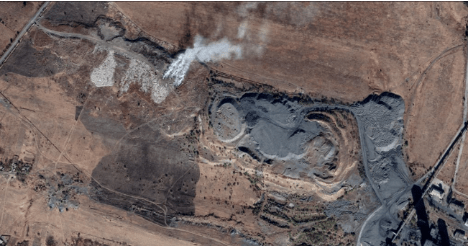
Rock dump fire at Volynska Mine, Shakhtarsk city, Donetsk region. Recorded on a high spatial resolution satellite image from October 15, 2020 (temporarily occupied territory since 2014).
GoldenRAM: the platform in focus
The presentation focused on the GoldenRAM platform’s architecture, functionality, and Artificial Intelligence Knowledge Packs (AIKPs) — the modular analytical components that power domain-specific analysis across the mining lifecycle. GoldenRAM offers a high-performance computing geospatial platform developed with funds from the EU, OPT/NET and other international partners.
What are AIKPs? Artificial Intelligence Knowledge Packs are specialist analytical modules embedded within the GoldenRAM platform. Each AIKP brings domain-specific logic to a particular challenge — geological mapping, volumetric change detection, environmental monitoring — automating workflows that would otherwise require expert manual interpretation of satellite data.
Specifically, the platform operates across three AIKP domains:
- Exploration AIKPs — modules for geological exploration and mineralogical mapping from satellite and airborne data.
- Production, safety & operations AIKPs — tools for monitoring open-pit slope stability, tailings dam integrity, and volumetric changes using multi-temporal digital elevation models (DEMs).
- Environmental AIKPs — components for vegetation health assessment, water quality monitoring, and detection of acid mine drainage.
Beyond the AIKP structure, the platform ingests a wide range of input formats, such as GeoTIFF, NetCDF, SAFE/HDF, LAS/LAZ point clouds, shapefiles, and more, and combines satellite, airborne, drone, and proximity sensor data through heterogeneous multimodal fusion. Outputs include cloud-optimised GeoTIFFs (COG), GeoJSON, 3D tiles (GLB), and PDF reports, making results accessible to both technical specialists and operational decision-makers.
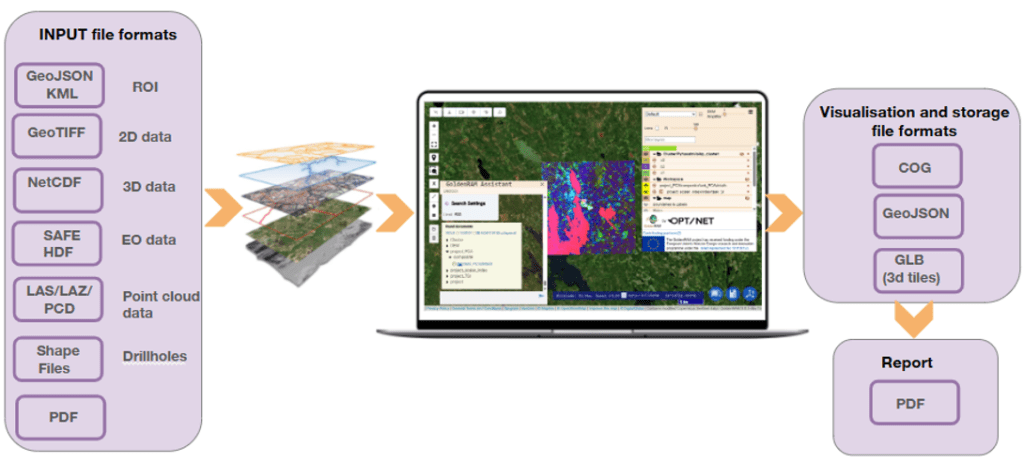
The GoldenRAM Platform Data file formats
Audience response
The presentation generated significant interest from conference attendees, particularly around the practical application of diverse geospatial datasets as direct replacements for on-site surveys in hazardous or inaccessible areas. The convergence of AI-driven automation, satellite data, and domain-specific knowledge in a single platform resonated with participants working on both technical and industrial challenges.
The GoldenRAM team thanks the ITMM 2026 organisers and the wider USUST community for the opportunity to share this work and looks forward to continued collaboration with Ukrainian research and industry partners.
→ ITMM-2026 Conference → USUST / DMI News
Conference proceedings
The work presented at ITMM 2026 has since been published in the conference proceedings. Kavats, Sergieieva and Matselyukh set out the DEM-based approach to volume change monitoring in detail, alongside the AIKP architecture behind it. The paper is available under DOI 10.34185/1991-7848.itmm.2026.01.078.
This work was supported by the European Union under Grant Agreement No. 101138153 — “GoldenRAM: EO Platform Supporting Critical Raw Materials Industry in Europe”. The views expressed are those of the author(s) and do not necessarily reflect those of the European Union or its delegated agency HaDEA.